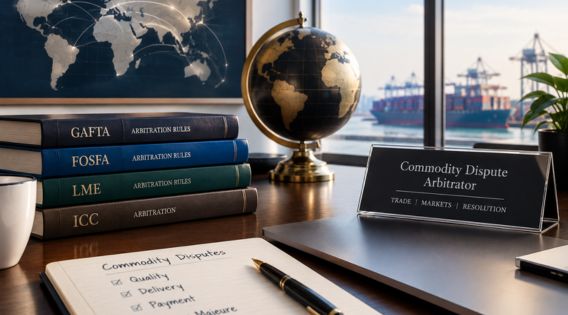
International commodity trading moves at a pace few other industries can match. Cargoes of grain, oilseeds, metals and energy products change hands across multiple jurisdictions within days, often through a chain of back-to-back contracts. When a dispute arises over quality, delivery, payment or force majeure, the parties rarely have the luxury of a multi-year court process. This is precisely why the industry has, since the nineteenth century, relied on specialist arbitration rather than domestic litigation, and why the choice of a qualified commodity dispute arbitrator is treated as a commercial priority rather than a legal afterthought.
A Distinct Arbitration Culture
Commodity arbitration operates differently from mainstream commercial arbitration. Trade associations such as the Grain and Feed Trade Association (GAFTA), the Federation of Oils, Seeds and Fats Associations (FOSFA) and the London Metal Exchange (LME) each administer their own arbitration rules, built into the standard-form contracts that govern the majority of global soft-commodity and metals trade. These proceedings are typically decided on documents alone, with in-person hearings the exception rather than the rule, and most carry a two-tier structure: a first-tier award followed, where challenged, by a full appeal before a larger board. GAFTA’s rules also permit a single “string arbitration” to resolve a chain of materially identical contracts between the first seller and the last buyer, sparing the parties from repeating the same dispute at every link in the chain.
Where Metals and Shipping Intersect the Trade
A commodity dispute rarely stays confined to a single contract. A cargo dispute under a metals sale contract can raise the same delivery and title issues that arise in a metal dispute arbitrator appointment, concession terms, royalty calculations, and LME-linked pricing disputes, where awards are enforced through the English High Court, and parties retain a limited right of appeal on points of law. At the same time, the vessel carrying the cargo is usually governed by a separate charterparty, which is why disputes in this sector frequently call for a shipping dispute arbitrator who understands how trade-association rules interact with London Maritime Arbitrators Association practice. London remains the dominant seat for this overlap, handling the large majority of the world’s maritime arbitrations and underpinning the English-law charterparties, bills of lading, and marine insurance contracts that commodity trades depend on.
The Case for a Sole Arbitrator
Parties negotiating a commodity contract must also decide how many arbitrators will hear a future dispute. Under the ICC Rules, a sole arbitrator is the default position unless the dispute is valued above roughly USD 5 million or otherwise warrants a three-member tribunal; the LCIA Rules adopt a similar presumption in favor of a sole arbitrator unless the parties agree, or the circumstances require, otherwise. For commodity disputes which are often time-sensitive and turn on a discrete factual question such as quality certification or a missed shipment window, a single arbitrator can resolve matters faster and at a fraction of the cost of a three-member panel, without the scheduling delays that come with coordinating multiple arbitrators’ diaries.
The International Arbitrator is currently accepting appointment as Sole Arbitrator in commodity, metals and shipping disputes worldwide, bringing triple qualification across the United States, England and Wales, and India to proceedings seated in London, New York, Geneva, Singapore and beyond. Businesses, legal counsel and arbitral institutions seeking a neutral decision-maker with direct experience of trade-association rules, LME-linked metals disputes, and the charterparty issues that so often accompany a commodity claim can request an appointment for a specific dispute.
A Global, Trader-Facing Discipline
Unlike a standard commercial tribunal composed of lawyers, commodity arbitration panels have traditionally drawn on practitioners with direct trading experience, a feature that continues to shape how disputes are argued and decided. Geneva, home to major trading houses including Vitol, Trafigura, Glencore, Cargill and Louis Dreyfus, has grown into a leading seat for high-value commodity and energy claims, often valued for its neutrality between counterparties from sanctioned and Western jurisdictions alike. London continues to govern the majority of the world’s grain, oilseed and soft-commodity trade through GAFTA and FOSFA, while Singapore and Hong Kong increasingly handle Asia-Pacific flows in palm oil, coal, and metals. For any party facing a cross-border commodity dispute, the right arbitrator is one who moves comfortably between these institutional cultures and who can be appointed quickly enough to match the pace of the trade itself.